

Brave said on November 11, 2026, that it will start encrypting the result links in Brave Search, in a post on the Brave blog, first detailed by CyberInsider. Brave Search is now the second major search engine to hide destination URLs from scrapers. Google did the same in August. Rank tracking vendors, SERP API providers and the AI products built on them are the ones affected.
How Brave Search encrypted links work
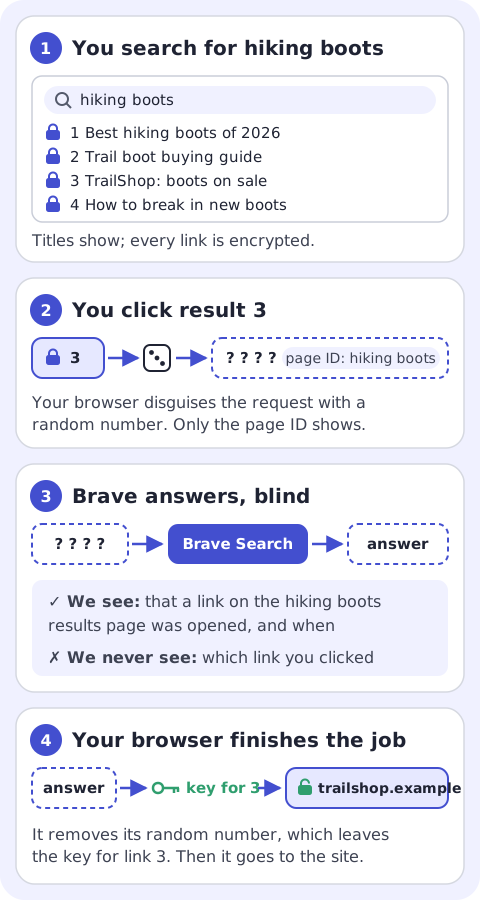
When you hover over a result, the link will point to a search.brave.com/go/v1 address instead of the destination. The real URL sits after the hash, in encrypted form.
When a user clicks, the browser sends a randomized request to Brave. It gets back what it needs to decrypt that one URL locally, then opens the destination directly. Brave says it uses a partially oblivious pseudorandom function. Brave can see which results page the request came from and when, but not which result the user picked.
The cost lands on bots. Each response unlocks a single URL. A scraper that wants every destination on a page has to make one request per result, and Brave can count those requests per page.
Brave notes some trade-offs:
- Without JavaScript, Brave falls back to a normal server-side redirect, which reveals the clicked destination.
- Links copied from the results page are Brave URLs and can expire. To keep a link, open the page and copy it from the address bar.
- A trusted-looking Brave URL could be abused for phishing. Brave says it has added link invalidation, expiry limits and an intermediate warning page.
Why scrapers moved from Google to Brave
Brave says the problem started with Google. On X, it said Google's GOTO change "created a bot problem for Brave Search and its users." Scrapers that couldn't get clean results from Google moved to Brave. The traffic forced tighter bot defenses, which meant slower results and more CAPTCHAs for real users.
Confirmed, reported and unconfirmed:
- Confirmed by Brave: encrypted links, the reason (scraper traffic after Google's GOTO change) and rollout "in the upcoming days."
- Confirmed by Brave: traffic spikes of "several thousand requests per second."
- Unconfirmed: exact rollout date and rate limits per user. Brave does not say whether the change touches its Search API, but it points anyone who wants results at scale to the API as its "front door."
Google's GOTO links set this off
- July 2026: Google starts testing google.com/goto passthrough links in results, Search Engine Roundtable reports.
- August 26, 2026: Google confirms the rollout. A spokesperson cites "technical measures against evolving forms of abuse." Google never mentioned scrapers.
- August 2026: Nozzle founder Derek Perkins estimates that resolving every link for a five-page ranking takes 500 to 1,000 requests, PPC Land reports.
- October 30, 2026: Google starts limiting how fast GOTO links can be resolved. Serper and SerpApi report production impact, and Serper now resolves only the first three organic URLs, according to Context.dev.
- November 11, 2026: Brave announces encrypted links.
Takeaway: Google closed the door, scrapers moved to Brave, and now Brave is closing its own.
What Brave's encrypted links mean for SEO tools and AI products
Our take: cheap SERP data is running out. For years, rank trackers, SERP APIs and AI agents have relied on scraping results pages at scale. Google made that slow and costly in August. Brave was the obvious fallback, with its own index and fewer defenses, and it is now adding the same per-result cost. Expect the trade-offs already seen after Google's num=100 change in 2025: higher prices, shallower tracking depth or both.
Brave isn't shutting out developers. It sells a Search API, free for personal use and paid for commercial use, and its fight is with unauthorized scraping. That nudges AI builders toward paid, licensed index access, which may be the real point.
For marketers, rankings themselves don't change. What changes is how much it costs to measure them, and whether that data is reliable.
What to do now:
- Ask your rank tracker and SERP API vendors how they handle Google GOTO and Brave go/v1 links, and whether results beyond the top few are fully resolved.
- Check your tracking data for missing URLs or sudden gaps since late October, when Google's rate limits started.
- If you track Brave Search rankings, expect new gaps once the rollout starts, and log the start date.
- Budget for price increases from SERP data providers in 2027 contracts.
- If you build AI tools on scraped results, compare costs for official APIs, such as Brave's Search API, before the scraping route breaks.
What to watch
Watch for the exact Brave rollout date, any rate limits Brave publishes, and whether other engines that run their own index follow. Also watch whether SERP API vendors raise prices or reduce how deep they track.
Scraping search results at scale was never officially allowed. Now it has a direct cost per result, and SEO tools and AI products will pass that cost on.
Credit: CyberInsider first reported the details of Brave's encrypted link system.