

Google released Gemini 4 Hydrogen on November 12, 2026, and made it the new default model in AI Mode the same day. For SEOs, Google says the model brings a wider fan-out and more links to more sites. It arrived two days into a core update, so the effect will be hard to measure. Sites that get traffic from AI Mode and AI Overviews feel this first.
What Gemini 4 Hydrogen changes in Google Search
Google's model announcement says Hydrogen is rolling out to Google Search for everyone, and the Search post says it is "available globally in Google Search for all users." Robby Stein, VP of Product for Google Search, added on X that it is now the default in AI Mode and handles "your hardest questions" in AI Overviews.
Google lists three changes for Search:
- Better intent matching: multi-part questions, typos and very specific requests are understood more accurately.
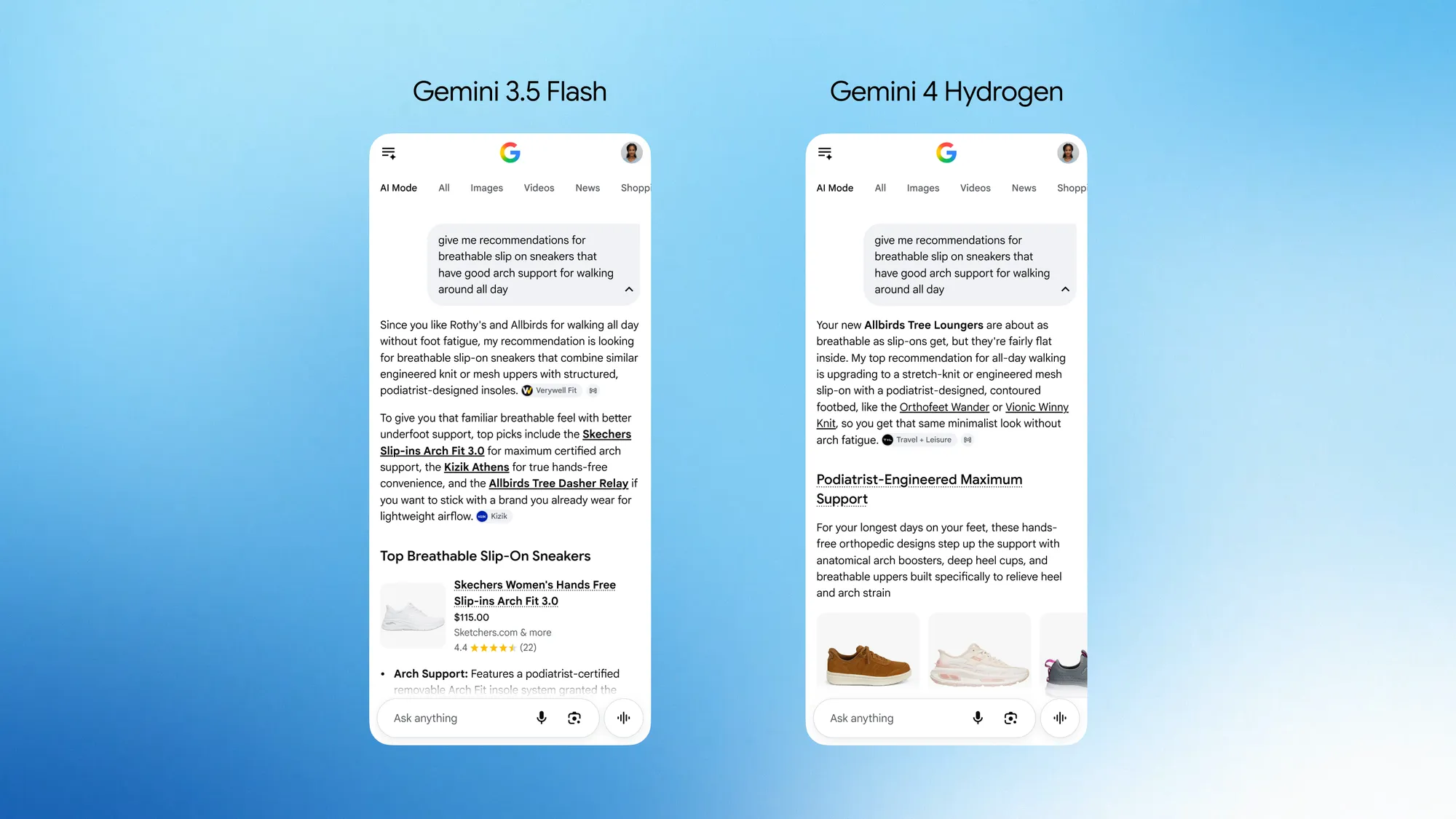
- More visual answers: more images, comparison tables, structured responses and custom tools.
- Wider fan-out: Hydrogen runs more searches across subtopics and links to sites users "might not have discovered."
Google's Rajan Patel added that answers now come "complete with even more links so you can discover sites."
There are also two model facts that matter for SEO. Google says Hydrogen makes fabricated claims more than 5x less often than Gemini 3.8 Flash. It also scores 51 on the Artificial Analysis Intelligence Index, above Gemini 4 Argon's 50. Both figures come from Google's own testing.
Confirmed, reported and unconfirmed
- Confirmed by Google: Hydrogen is the default in AI Mode for all users worldwide, it powers the hardest AI Overview questions, and it brings wider fan-out with more links.
- Reported: a data bug hit Search Console's Generative AI performance report from November 9 to 11, Search Engine Roundtable reports, so AI feature impressions for those days are unreliable.
- Unconfirmed: how many more links Hydrogen shows, which AI Overview questions count as "hardest," and which model AI Mode used before. Search Engine Journal notes that Google's posts don't say.
Four changes in one week
- January 2026: Gemini 3 becomes the global default for AI Overviews, per Search Engine Journal.
- May 2026: AI Mode passes one billion monthly users, and Gemini 3.5 Flash becomes its default at Google I/O.
- October 13, 2026: Gemini 4 Argon reaches paid AI Pro and Ultra subscribers.
- October 29, 2026: Reddit CEO Steve Huffman says AI Mode does not drive traffic, PPC Land reports.
- November 10, 2026: the November core update begins, and Gemini 4 Carbon reaches AI Mode for Ultra subscribers.
- November 12, 2026: Hydrogen becomes the AI Mode default for everyone.
Takeaway: from November 9 to 12, Search got a core update, a reporting bug and a new AI Mode model. No single cause will explain this month's numbers.
What Gemini 4 Hydrogen means for SEO
Our take: Hydrogen changes how your content gets used in AI answers, not where your pages rank in blue links. Barry Schwartz at Search Engine Roundtable reads it the same way: it affects AI Overviews and AI Mode, not core rankings.
Three effects are worth watching.
Wider fan-out favors specific pages. Each sub-query looks for one narrow answer. A page that answers one subtopic completely has a better chance of being pulled in than a broad page that covers ten topics thinly. If Google's claim holds, smaller sites that rarely got cited may start appearing.
More links does not mean more clicks. Google gave no numbers. Reddit told investors in October that AI Mode doesn't drive traffic. More citations in an answer can still mean fewer visits per citation.
Better accuracy cuts both ways. A model that invents fewer facts repeats what it finds more faithfully. If your product details, prices or policies are out of date, AI Mode is now more likely to repeat the outdated version accurately.
What to do now:
- Mark November 10 (core update) and November 12 (Hydrogen) in GA4, Search Console and client reports. Ignore November 9 to 11 in the Generative AI performance report.
- Use Search Console's Generative AI performance report to compare AI feature impressions before and after November 12. It shows no clicks or queries, so also run a fixed set of multi-part questions for your topics now, and again after the core update ends.
- Check that your key pages answer one subtopic each, completely, with facts easy to pull into a comparison table.
- Update product, pricing and policy pages, since a more accurate model will repeat whatever it finds.
- Hold off on big content changes until a full week after Google confirms the core update is complete.
What to watch
Watch for Google defining which AI Overview questions count as "hardest," for clicks and queries added to Search Console's Generative AI performance report, and for third-party citation data from tools tracking AI Mode before and after November 12. Also check the Search Status Dashboard for the core update's completion date.
Hydrogen could send more sites into AI Mode answers. Until Google shares numbers, or your own data shows it, treat "more links" as a claim, not a traffic forecast.