

Google released the November 2026 core update on November 10, according to the Search Status Dashboard, and the rollout may take up to two weeks. Rankings across all languages may move through most of the run-up to the holiday shopping season. Ecommerce sites, affiliates and publishers with seasonal content have the most at stake.
What Google confirmed about the November 2026 core update
Google Search Central announced the update on LinkedIn. It calls this a regular update aimed at surfacing "relevant, satisfying content for searchers from all types of sites." That is the same description Google used for the May 2026 core update.
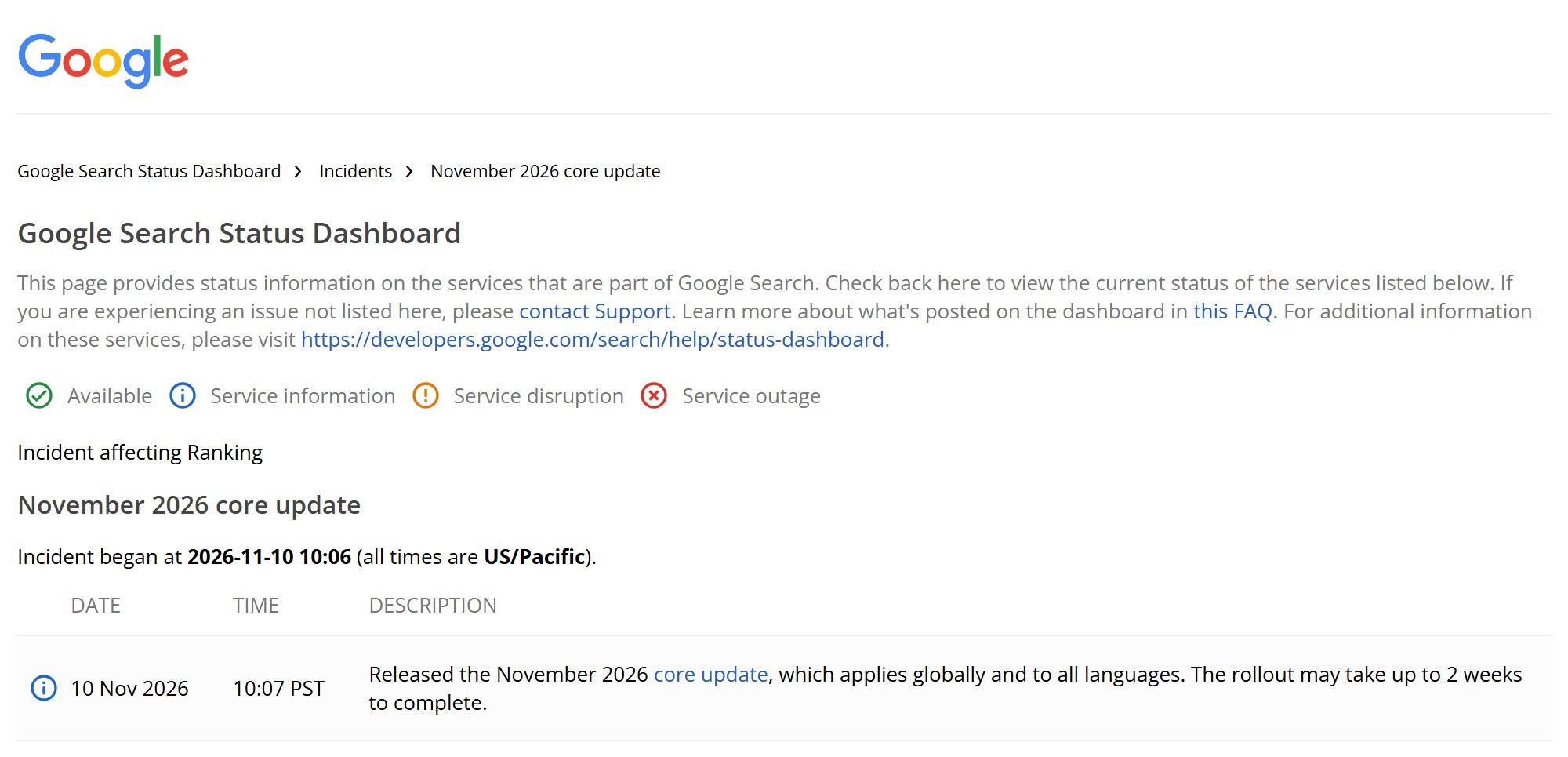
The Search Status Dashboard logged the update at 10:06 a.m. Pacific on November 10. The entry adds two details: the update "applies globally and to all languages," and the rollout "may take up to 2 weeks to complete."
Google published no blog post, listed no specific goals and did not say which systems changed. It will mark the update complete on its ranking release history page.
Confirmed, reported and unconfirmed
- Confirmed by Google: start date, global scope in all languages, rollout of up to two weeks, and that this is a regular core update.
- Reported: none yet. Tracking tools need several days of data before any patterns show.
- Unconfirmed: whether Discover, AI Overviews or AI Mode are affected. Earlier core updates have touched Discover and featured snippets, according to Search Engine Roundtable.
The third core update of 2026, after a five-month gap
This is the longest gap between core updates this year. The May 2026 core update finished on June 2, which is 161 days before this one started. Only about six weeks separated the March and May updates.
Google has run three spam updates in between, in June, August and September.
Google ranking updates in 2026, per the Search Status Dashboard:
| Update | Started | Duration |
|---|---|---|
| February 2026 Discover update | Feb 5 | 21 days, 17 hours |
| March 2026 spam update | Mar 24 | 19 hours, 30 minutes |
| March 2026 core update | Mar 27 | 12 days, 4 hours |
| May 2026 core update | May 21 | 11 days, 21 hours |
| June 2026 spam update | Jun 24 | 2 days, 1 hour |
| August 2026 spam update | Aug 18 | 2 days, 16 hours |
| September 2026 spam update | Sep 24 | 13 days, 16 hours |
| November 2026 core update | Nov 10 | In progress |
Source: Google Search Status Dashboard.
Takeaway: both earlier 2026 core updates finished in about 12 days. If this one runs the same, it would end around November 22.
What the November core update means for SEOs
Our take: the timing matters more than the update itself. A core update that runs until Black Friday leaves ecommerce and affiliate sites no time to recover before peak season. Any position drop in the next two weeks will show up in holiday revenue. And because this is the first core update in five months, many sites will see their first broad reassessment since spring.
Google's own documentation warns against reacting early. Core updates don't target specific sites, and most sites don't need to act. A large, sustained drop is a reason to review whether the whole site is helpful and reliable. A small drop during the rollout is not.
What to do now:
- Note November 10 as the start date in GA4 and Search Console reports, and in any client dashboards, so the volatility has context.
- Don't make big changes during the rollout. Avoid redirects, URL changes, content pruning and template changes until Google confirms the update is complete.
- Watch Web Search, Discover, Images and News separately in Search Console. Google's guidance treats each one separately.
- Prepare for the holidays without depending on organic rankings alone. Have email, paid search and shopping campaigns ready in case positions move on key category pages.
- Once the update is complete, wait a full week, then compare that week with the week before November 10.
What to watch during the rollout
Watch ranking volatility trackers through the first two weekends. In May, volatility peaked on the weekends after launch, as reported by Search Engine Roundtable. Watch for Google's completion notice on the dashboard, and for whether it lands before or after Thanksgiving week. Also look for early data from Sistrix, Semrush and other trackers on which site types gained and which lost.
Two weeks of volatility ahead of the biggest shopping week of the year is reason for caution, not panic. Record a baseline now, keep the site stable, and judge the results after the update finishes.